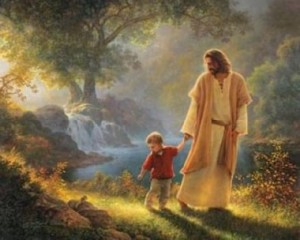
 For unto us a child is born, unto us a son is given: and the government shall be upon his shoulder: and his name shall be called Wonderful, Counselor, The mighty God, The everlasting Father, The Prince of Peace. (Isaiah 9:6, KJ2000)
In this familiar verse prophesying the Christ and His attributes, I would like to focus on the first one mentioned, “Unto us a Son is given.” When the Father sent Christ to walk among us, He did not come in the form of a prince or king, born in a palace. Neither did he come as a candidate for the position of High Priest in the temple. In fact, He was not even born a Levite, but rather of the tribe of Juda. Though it was prophesied that an eternal scepter would rise in the tribe of Juda (see Genesis 49:10), Christ had to first come as a lowly carpenter’s son in a back water town called Nazareth in downtrodden Israel, a nation that had been continuously conquered and oppressed for hundreds of years.
Yes, a Son has been given us. Why did Jesus take the lowly title of “Son of man?” He came to lead the way as the prototype of what the Father wants. He was the First Born of the many sons (and daughters) of God! Paul wrote in the book of Romans saying,
We know that in everything God works for good with those who love him, who are called according to his purpose. For those whom he foreknew he also predestined to be conformed to the image of his Son, in order that he might be the first-born among many brethren. (Romans 8:28-29, RSV)
The sonship of man as sons of God has been in the mind of our Father from the beginning. When we read the genealogy of Christ in Luke’s gospel we read, “Kenan was the son of Enosh. Enosh was the son of Seth. Seth was the son of Adam. Adam was the son of God.” (Luke 3:38, NLT)
T. Austin-Sparks wrote,
But in the same eternal counsels which determined that Christ should be the center and sphere of universal fullness, by divine appointment and undertaking the church, His body, was linked with Him to be “the fullness of Him that filleth all in all“; those are the closing words of Ephesians chapter one.
That means that unto that sonship the church is brought, and so we have a parallel revelation in the New Testament concerning the sonship of believers as God’s full thought, and you have this remarkable word at the beginning of this letter, in verse [Ephesians 1:] 5: “Having foreordained us unto the adoption as sons by Jesus Christ unto himself.” *
What a high calling! We who belong to the Father in heaven are all called to be His sons (and daughters). All the workings of God in our lives are for one reason, to bring us into full sonship after the image of Christ. One important thing we must realize is that just as we are born to our mothers as infants, we are born into the kingdom of God as spiritual infants. There is a growing-up process that God requires each of us to go through. Christ had to learn obedience through the things that He suffered, and so it is with us (See Hebrews 12:5-8).
“For unto us a child is born, unto us a son is given.” In the economy of God, children are born (“you must be born again”), but sons are given by the outworking of our loving Father in us.
All praise to God, the Father of our Lord Jesus Christ, who has blessed us with every spiritual blessing in the heavenly realms because we are united with Christ. Even before He made the world, God loved us and chose us in Christ to be holy and without fault in His eyes. (Ephesians 1:3,4 NLT)
Austin-Sparks continued:
That which has been chosen before the foundation of the world and which has been foreordained unto adoption as sons through Jesus Christ, has been blessed with every spiritual blessing in the heavenlies. That is the fullness of God’s thought for His own, as a full, comprehensive, utter thought. We have not yet come into all those blessings, not because God has not given them, but because we have not grown up into them. We have not grown up into Him in all things. That is the point of our word, the urge to come to God’s thought, the measure of Christ. What is God’s thought? The full measure of Christ, the fullness of the stature of Christ. *
There is the principle of life and death in spiritual growth. You cannot have one without the other. Paul wrote, “If, because of one man’s [Adam’s] trespass, death reigned through that one man, much more will those who receive the abundance of grace and the free gift of righteousness reign in life through the one man Jesus Christ. (Romans 5:17, RSV)
Jesus was even more specific saying,
He who does not take his cross and follow me is not worthy of me. He who finds his [soul] life will lose it, and he who loses his life for my sake will find it. (Matthew 10:38-39, rsv)
Verily, verily, I say unto you, Except a grain of wheat falls into the ground and dies, it abides alone: but if it dies, it brings forth much fruit. He that loves his life shall lose it; and he that hates his life in this world shall keep it unto life eternal. (John 12:24-25, KJ2000)
Finally, let me conclude by quoting once more from brother Sparks.
It means that death has continually to work in the realm of that which is rejected of God, in order to make room for that which is accepted of God. In other words, it is a case of death operating continually to get us out of the way in order to bring Christ in. The increase, the fullness, whether it be in life or in ministry, must ever and always be by the operation of death to all that is of the old creation about us, and resurrection in which only Christ appears. Resurrection implies Christ. God has never raised the old creation. He has, in the death of Christ, crucified it, buried it, and He has never raised it. What He has raised is that which is wholly acceptable to Him.
So it proves. We go into experiences of deep, dark and painful suffering, in which some more of the self-life is slain; some more of our own natural strength of mind and will is brought to the grave; some more of the “I” is put out, and we come up out of that deep experience each time with something more of the Lord, an increase of Christ. So we grow by the law of death and resurrection, the law of the grain of wheat.
Ministry is on that basis. Those who have the greatest measure of Christ and His riches to give are those who have suffered most, because in their suffering, that which was in the way of Christ has been removed; and all suffering is to that end. What a shame that so often we do not allow the suffering to do its work. We either revolt and rebel against it and become bitter, or resist the thought of what it is unto and take the martyr attitude of self-pity. No, God’s dealings with us in all suffering are unto an increase of Christ, firstly for our own enlargement, our coming to a greater measure of His fullness, the stature of Christ, and then that we may have more of Christ to give. For ministry this law operates – death and resurrection. It is the way of divine increase.
So let us take God’s thought again, the fullness of Christ, and see that His thought is made to govern all His dealings with us. And surely we shall consent, and yield to Him if we truly see that God is working. It may be though haply by the difficult, painful, breaking, grinding way in order to save us from that of ourselves which occupies the place that Christ should occupy. This is so that He in all things might have the preeminence, be all and in all, fill all things, and then that others should come into the increase of that ministry, where the members are able to minister Christ. It is a very blessed thing, and this is the way. *
Paul wrote, “For we who live are always delivered unto death for Jesus’ sake, that the life also of Jesus might be made manifest in our mortal flesh. So then death works in us, but life in you.” (2 Corinthians 4:11-12, KJ2000)






 A Wilderness Voice