 In Genesis we read about God’s plan for the creation of man:
Then God said, “Let us make man in our image, after our likeness…” So God created man in his own image, in the image of God he created him; male and female he created them. (Gen 1:26-27, ESV2011)
Here we see there was a council in heaven when it comes to the creation of man, “Let us make man…” When He created all other things He simply said, “let there be… and there was…” Why did God consult the Son and the Spirit at this point? It was because He knew that it was one thing to make man in His own image, that is, designed and shaped after His own form, but that it would take an ongoing process and great sacrifice to make man in His likeness, that is, like Him in His character and personage, sharing His outlook, goals and values. It was at this point that Jesus agreed with the Father about His role in bringing forth man into the image of the Son. We read about it in Paul’s letter to the Ephesians.
Blessed be the God and Father of our Lord Jesus Christ, who has blessed us in Christ with every spiritual blessing in the heavenly places, even as he chose us IN HIM before the foundation of the world, that we should be holy and blameless before him. In love he predestined us for adoption as sons through Jesus Christ, according to the purpose of his will, to the praise of his glorious grace, with which he has blessed us in the Beloved. IN HIM we have redemption through his blood, the forgiveness of our trespasses, according to the riches of his grace… (Eph 1:3-6, ESV2011- emphasis added)
This is why the Father brought Jesus and the Holy Spirit into His council at this point. Christ is the exact expression of the Father, “He [Christ] is the radiance of the glory of God and the exact imprint [image] of his nature…” (Heb 1:3, ESV2011), and God desires many sons and daughters after His own glory. It was one thing to make man after His image, but a whole other thing to make man so that he lives out the very nature of God in His Son. Here entered the mystery of the cross.
The Father also knew that unless His Spirit was the life source of man, he would only be two dimensional in nature, lacking any way to connect and communicate with God, spirit to spirit. God is Spirit and man would have to be born of the Spirit or there would be no connection for man to intuitively know the will of God for him (See John chapter three).
There is knowledge and then there is Knowledge!
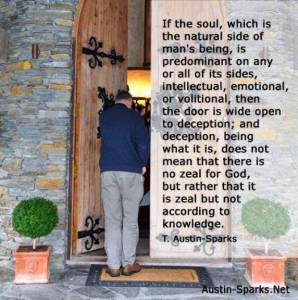 At this point in the creation story of man, a wrench was thrown into the works. Satan stepped in and convinced man that he could speed up the process. Man no longer had to listen to and obey God, but he could take a “short-cut to holiness” by eating of the tree of the knowledge of good and evil to become “like God” (See Genesis 3:5).
Beware, dear saints for right here is where Satan desires to catch us all in his subterfuge of lies. Aren’t we to become “godlike?” Aren’t we to strive to obtain “the imitation of Christ”? Aren’t we to constantly ask ourselves, “What would Jesus do,” and then just do it? Man loves to try to do the works of God, accumulate knowledge, know with his own mind, and imitate God instead of knowing God intimately with his heart and allowing God to conform him into the image of Christ by the plan and design of the Father. The fleshly state of fallen man still loves to eat the fruit of that same forbidden tree instead of Jesus, the Tree of Life (See John 6:51).
Religious man loves to collect Bible knowledge and knowledge of doctrines so he can decide for himself what is good and what is evil. He loves to heap to himself teachers that tickle his religious ears and to garner to himself degrees in theology. Yet, when the New Testament speaks of “knowing the Lord,” it speaks of an intimate knowing that goes much deeper than a mere accumulation of facts. W. E. Vine gives the most concise meaning of this Greek word translated know and knew in the New Testament.
In the NT ginosko frequently indicates a relation between the person “knowing” and the object known; in this respect, what is “known” is of value or importance to the one who knows, and hence the establishment of the relationship…
Without a viable relationship in Jesus Christ there is no knowing and being known by the Father. Peter put it this way:
For this very reason, make every effort to supplement your faith with virtue, and virtue with knowledge, and knowledge with self-control, and self-control with steadfastness, and steadfastness with godliness, and godliness with brotherly affection, and brotherly affection with love. For if these qualities are yours and are increasing, they keep you from being ineffective or unfruitful in the knowledge of our Lord Jesus Christ. (2Pet 1:5-8, ESV2011- emphasis added)
Here Peter is speaking spiritual fruitfulness by what Paul calls the “fruit of the Spirit,” which is an integral part of us if we truly know the Lord and if He knows us. Without it we will be unfruitful in our relationship with Him. This is why Jesus spoke of those who did many works and miraculous things “in His name” as those He never knew (see Matthew 7:22-23). There was no intimacy in their “knowing” Him and in His “knowing” them. This same word ginosko was used in the most intimate way when speaking of Joseph and Mary’s relationship after Christ was born (see Matthew 1:25). Without intimacy with Christ, there is no knowing in the kingdom of God.
 Back to my opening question, Does the end justify the means when it comes to our serving in the purposes of God? Jesus told Nicodemus, “That which is born of [out from] the flesh is flesh; and that which is born of [out from] the Spirit is spirit.” (John 3:6). You see, if we are to produce fruit unto the Father and the Son, that fruit must be born out from the Spirit of God in us and never out from ourselves. His children must be born “not of blood, nor of the will of the flesh, nor of the will of man, but of God,” and so must our works be if they are to be works unto eternal life (See Jude 1:21).
We cannot rise in the morning and say, “I wonder how many people I can lead to Christ today?” or, “I think I will cast out some demons today ”or “I think I will pray for so and so to be healed today,” or not even “I think I will write a blog article today.” This is all being done by the will of the flesh, dear saints, not by the will of God! Jesus said quite bluntly, “Apart from me you can do nothing!” If our works are not born from above in the council of the heaven and He has foreordained that we should walk in them (see Ephesians 2:10), they are dead works at best. Yup! They are D. O. A., dead on arrival. Our ends do not justify His means and His ends are not justified by our means. We Christians must learn what Jesus meant when He told the disciples, “It is the spirit that gives life; the flesh profits nothing: the words that I speak unto you, they are spirit, and they are life.” (John 6:63, KJ2000).
Are we as Christians living by “every word that proceeds from the mouth of God?” I think not. And until our flesh and all its self-motivated drives have been crucified, we will not know the abundant life flow of God through us to others. Like Jesus said:
You have not chosen me, but I have chosen you, and ordained you, that you should go and bring forth fruit, and that your fruit should remain: that whatsoever you shall ask of the Father in my name, he may give it to you. (John 15:16, KJ2000)
 Dear saints, by now you are wondering where I am coming from to write such an article. Almost 37 years ago, I was doing all manner of “good works and prophesying in Christ’s name.” After watching me for a while, an old saint came up to me on Sunday morning and said, “Have you ever asked God to show you how He sees you, instead of how you think He sees you?” In my pride, I told him that I would take him up on his challenge and I did just that. That night I asked God, and He showed me in a dream just how I looked to Him, using my spiritual talents and gifts to do His work. The pride and arrogance that was behind all my works was so ugly that I cried out, “God! Kill it! Show it no mercy!” That was the beginning of Him stripping me of all that I was and ever hoped to be “in His name.” At some point in your life you will be brought to this crisis if you are to follow on with the Lord and you will be shocked at what God shows you about your own heart.
Then shall we know, if we follow on to know the LORD: his going forth is prepared as the morning; and he shall come unto us as the rain, as the latter and former rain unto the earth. (Hos 6:3, KJV)
There is knowing and then there is “following on to know.” Will we keep listening and following on to know the Lord in an ever growing intimacy with Him or just be content with what we already know? Remember, knowledge puffs us up, but His love edifies.
The Life Is in the Blood
There is a lot of talk in some circles about being in the army of God. Remember that before God could form His army from that valley of dry bones in Ezekiel chapter 37 there was a requirement. In verse two the prophet said, “and lo, they [the bones] were very dry.” Dry was not good enough. When God strips us of all the life of the flesh in us, our outside appearance might be dry, but that is not dead enough. Even the marrow inside our “bones” (our natural Adamic life) must be dry and void of all life. Why? “The life is in the blood” and the blood in us comes from the marrow in the depths of our bones. Our very Life Source must be the blood of Jesus Christ and nothing else. In John chapter six we read about His blood and His words that are necessary if we are to have eternal life within us.
Whoever feeds on my flesh and drinks my blood abides in me, and I in him. As the living Father sent me, and I live because of the Father, so whoever feeds on me, he also will live because of me… Jesus said these things in the synagogue, as he taught at Capernaum. When many of his disciples heard it, they said, “This is a hard saying; who can listen to it?” But Jesus, knowing in himself that his disciples were grumbling about this, said to them, “Do you take offense at this? …This is why I told you that no one can come to me unless it is granted him by the Father.” After this many of his disciples turned back and no longer walked with him. So Jesus said to the Twelve, “Do you want to go away as well?” Simon Peter answered him, “Lord, to whom shall we go? You have the words of eternal life,” (John 6:56-68, ESV2011)
Finally, let me quote once more from T. Austin-Sparks,
A living Heavenly Man is not made by mere words, even though they be words of Scripture. That is what people have tried to do. They have tried to make the Church by words of Scripture, constitute the Church by what is here as written, and so you have half a dozen different kinds of churches, all standing on what they call the Word of God, and the thing does not live. It is a living, Heavenly Man that God has in view, and to produce that, the Spirit must operate through the Word. “The words that I have spoken unto you are spirit, and are life,” said the Lord to His disciples. “Lord, to whom shall we go? Thou hast the words of eternal life.” On the part of Peter, the spokesman of these latter words, this was a word of discrimination. The scribes and Pharisees had the Scriptures. They claimed that everything they had and held was in the Word of God. Ah yes, but they knew them not as the words of eternal life. There is a difference. This life is in His Son. It has to be in a living relationship to the Lord Jesus that the Scriptures are made effective.
http://www.austin-sparks.net/english/books/001387.html
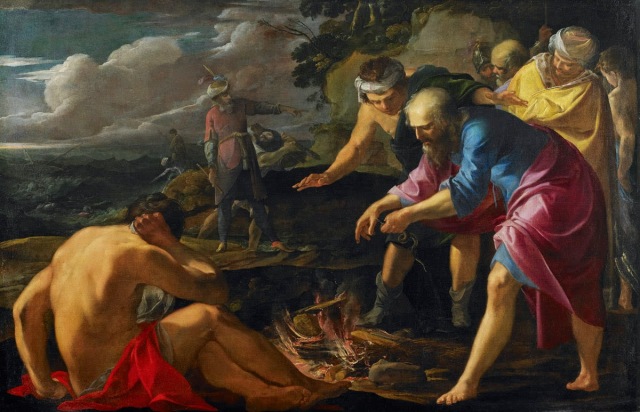 Paul wrote that we should not be ignorant of Satan’s devices. Many of us who have come out of organized Christianity have had to learn about his divisive ways in the process of sorting out all the false teachings we absorbed in that system from the voice of the Spirit in us. As we know, Satan can quote scripture to accomplish his twisted goals and vipers are of the very nature of the Great Serpent we must deal with. Jesus called the Pharisees (who often quoted scriptures) a “brood of vipers” as they tried to tempt Him with their logic.





 For we would not, brethren, have you ignorant of our trouble which came to us in Asia, that we were pressed out of measure, above strength, so that we despaired even of life: But we had the sentence [Grk, apokrima – an answer] of death in ourselves, that we should not trust in ourselves, but in God who raises the dead: (2Cor 1:8-9, KJ2000)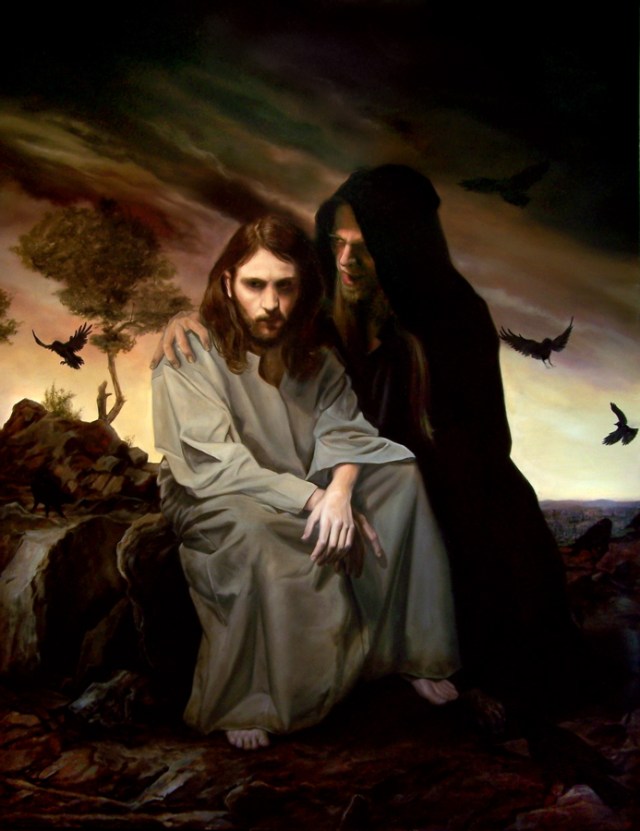
 A Wilderness Voice